Subtitle | From motion isolation to body-contouring support: a structural rethink of the mattress core
A quiet technological shift has already taken place inside the mattress core. The move from continuous coil systems to individually pocketed coils has changed more than how a mattress feels; it has changed how a mattress handles motion and the human form. For mid- to high-end products, pocketed coils are no longer an upgrade option — they are the default.
Traditional continuous coil systems are rigidly wired into a single interconnected unit. The problem is not the spring itself but the interconnection: deformation at any single point travels outward across the metal network. In testing, the kinetic energy generated when a 70 kg adult turns over produces no less than 35% transmitted vibration across a continuous coil surface — comparable to leaving a vibrating phone on the bed.
Two consequences follow directly:
Pocketed coils solve this by breaking the "network" into discrete "points." Each spring is individually wrapped and loaded, so vibration is absorbed stage by stage within the fabric pocket and the gaps between coils, achieving attenuation of up to 92% (Tsinghua University, Home Materials Mechanics Report 2024). This is the physical basis of the "one partner turns, the other never notices" effect. The Tianjin Institute of Quality Inspection's 2025 mattress durability testing likewise confirms that a discrete structure demonstrably blocks vibration transmission.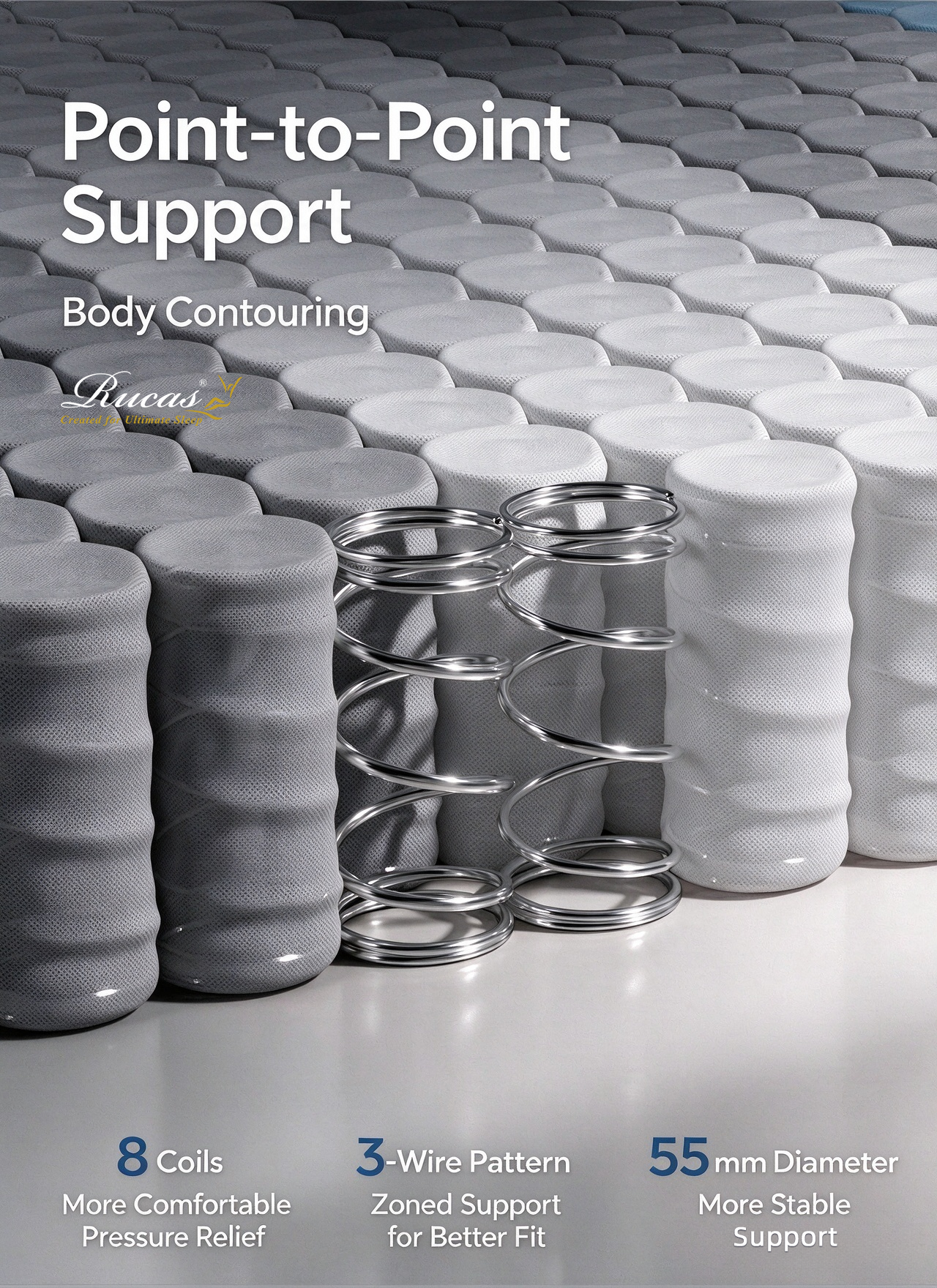
The human body is not a flat plane. The hips are a high-pressure zone, the waist a suspended zone, and the legs a low-pressure zone — each requires a different supporting force. Uniform support is, in principle, at odds with ergonomics. The value of pocketed coils lies in the ability to specify spring gauges by zone, producing a graded pressure response:
Data from an International Sleep Products Association (ISPA) certified laboratory shows this structure can reduce peak lumbar pressure by 41%. "Soft" here does not mean a soft material; it means the spring deforms to actively follow the body's contour — conformity achieved through deflection, not through collapse.
Early generations of pocketed coils did have real drawbacks. Recent advances in materials and manufacturing have addressed each of them:

Pocketed coils are not about being softer or more expensive. They address two fundamental contradictions in mattress design: vibration transmission and poor conformity to the body's contours. For couples, they remove the disturbance of a partner's movement; for the spine, they deliver targeted support that reduces fatigue; for the product lifecycle, they markedly lower replacement frequency. This is not a premium markup — it is the most cost-effective sleep solution available today.

